What to Pack for a Day Trip on a Yacht in Thailand
Planning a yacht day in Thailand? Pack reef-safe sunscreen, a hat, sunglasses, swimwear, a dry bag for your phone and cash, plus any daily medication. Check the national park sunscreen ban, since oxybenzone and octinoxate are prohibited. Split your belongings so the dry bag goes ashore while the rest stays on the boat.
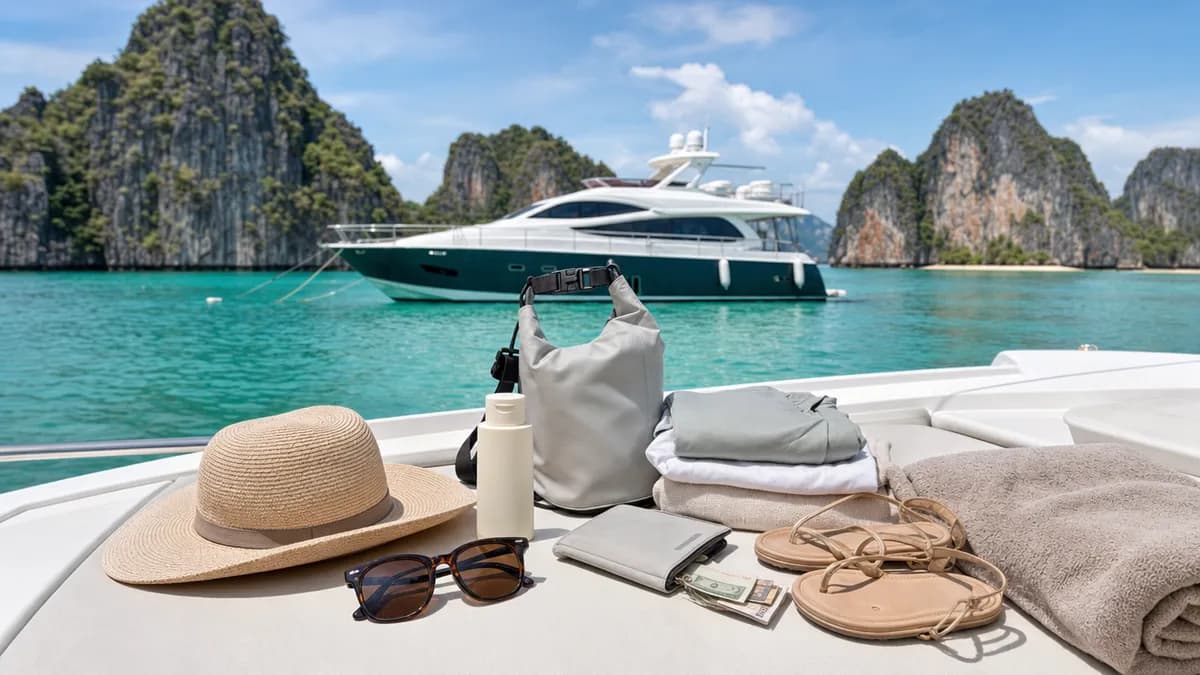
For a day on a yacht in Thailand, pack reef-safe sunscreen, a hat and sunglasses, swimwear and a dry change of clothes, a dry bag for your phone, cash, medication and sandals. Towels, drinking water and snorkel gear depend on the boat, so check first.
What should go on your packing list?
The list below is in order of importance. If you only have five minutes before the transfer arrives, pack from the top and stop where you run out of time.
Medication you take every day, and seasickness tablets if anyone in the group is prone to it. Nobody on board can replace them once you leave the pier.
Reef-safe sunscreen, a hat that will not blow away and sunglasses. Reflection from the water burns faster than a day on the beach.
A dry bag or waterproof phone pouch. It protects the phone, cards and car keys from spray and from the short ride to the beach.
Swimwear, worn under your clothes so you do not need to change on arrival.
A dry change of clothes and a light long-sleeved top for the ride home, when the wind on deck feels cooler than it is.
Cash in small notes for anything that is not part of your booking.
Sandals or flip-flops that you can slip off easily.
Your own snorkel mask, but only if you already have one that fits well.
Which sunscreen can you bring to national parks?
Many island routes in Thailand pass through national parks, and the sunscreen rule there is strict. Since August 2021, sunscreen containing oxybenzone, octinoxate, 4-methylbenzylidene camphor (4-MBC) or butylparaben may not be brought into or used in Thailand's national parks, and the fine is up to 100,000 baht, according to the Tourism Authority of Thailand (checked October 2026).
The four chemicals are listed on the back of the bottle, sometimes under other names: oxybenzone also appears as benzophenone-3, and octinoxate as ethylhexyl methoxycinnamate. A "reef safe" label on the front is a marketing claim, not a guarantee, so read the ingredient list. Mineral sunscreens based on zinc oxide or titanium dioxide do not contain any of the four. Buy the bottle before the trip, because the choice on a small island is limited.
What does the boat usually provide?
There is no single standard. A private yacht or catamaran in Thailand is run by its own operator, and what comes with the boat is set by that operator, not by a common rule. Towels, drinking water, soft drinks, fruit, snorkel masks and a cool box are common on larger boats, while a speedboat built for fast transfers often carries little more than water and life jackets.
The boat's description and the list of extras in the booking form are the place to check. If something matters to you, such as enough towels for the whole group or child-size snorkel masks, ask the operator through the booking chat before the day. It is a quicker conversation than finding out at the pier.
What is the most common packing mistake?
Packing for the boat and forgetting the trip to the beach. Most yachts anchor off the island because the water near the shore is too shallow for them, and guests go ashore in a small tender or swim the last few metres. At many beaches the tender cannot reach dry sand either, so you step out into knee-deep water with whatever you carry.
This is the moment when phones, passports in back pockets and paper money get wet, and it is why one big beach bag is the wrong choice. Split your things in two. The dry bag holds only what goes ashore: the phone, a card, some cash and sunscreen. Everything else stays on the boat in a normal bag, where it remains dry and the crew can see it.
Pack for the tender, not just the yacht.
Close the dry bag before you climb down the ladder, not after you are already in the tender. Waves are bigger next to the hull than they look from the deck, and the first splash usually comes on the way down.
What should you leave on shore?
Leave the hard suitcase and anything you would mind losing over the side. Space on deck is shared, and a rolling case is awkward to carry along a narrow pier and down into a boat. A soft bag that folds flat fits under a seat. Expensive jewellery and loose rings are better left in the hotel safe: they slip off easily in the water and are rarely found again.
Heels and hard-soled shoes are also best left behind. Many boats ask guests to go barefoot on deck to protect the surface and to avoid slipping, so the most practical shoes are the ones you can take off in a second and leave at the stern.
FAQ
Do I need to bring a towel on a yacht charter?
It depends on the boat. Many larger yachts and catamarans in Thailand provide towels for guests, while smaller boats and speedboats often do not. Check the boat's description or ask the operator in the booking chat before the day. If you are not sure, bring one quick-drying towel per person: it takes little space and is also useful as a cover against the sun.
Can I bring my own food and drinks on board?
Usually yes on a private charter, but the rules are set by each operator, and some include food or drinks in the price or offer them as extras. Ask before the trip so you do not pay twice. Choose plastic or cans over glass bottles, since glass breaks easily on a moving deck, and bring a cool bag if the boat does not mention a fridge or cool box.
Should I bring cash on a boat trip?
Yes, a small amount in Thai baht. Cash covers what is not part of your booking: drinks or snacks from beach vendors, small island shops and a tip for the crew if you want to leave one. Small notes are easier than large ones. Keep the cash in the dry bag together with your phone, so it stays dry when you go ashore by tender.
What shoes should I wear on a yacht?
Sandals or flip-flops that you can take off quickly. Many boats ask guests to stay barefoot on deck, so shoes are mainly for the pier and the beach. If the route includes rocky beaches or coral sand, water shoes protect your feet when you step out of the tender. Heels and hard soles are uncomfortable on a moving boat and can mark the deck.
How do I keep my phone safe on a boat?
Put it in a waterproof phone pouch or a dry bag before you leave the pier. Spray on deck, wet hands after swimming and the ride to the beach in a tender are the usual causes of damage. A pouch with a neck strap lets you take photos without taking the phone out. Keep it in the shade between photos, as phones overheat quickly in direct sun.
Is it worth bringing my own snorkel mask?
Only if you already own one that fits well. A mask that seals properly makes the difference between enjoying the reef and fighting leaks, and people who wear glasses may have a prescription mask of their own. Otherwise there is no need to buy one for the trip: many boats carry snorkel gear, and the boat's description or the operator will tell you whether it is included.